Showing posts with label Silent Spring. Show all posts
Showing posts with label Silent Spring. Show all posts


2/3/17
SUPERFUND 'Silent Spring' comes to life in DDT-stricken town, E&E News reporterGreenwire: Gabriel Dunsmith, Thursday, February 2, 2017


6/11/15
The more they dig, the more they find: DDT cleanup continues for mid-Michigan town. http://www.environmentalhealthnews.org/ehs/news/2015/jun/michigan-superfund-ddt-epa-birds-health-pesticide
ST. LOUIS, Mich. — During recent summers birds were found littered around the town, poisoned with a long-banned pesticide.
This summer? The school athletic grounds, where kids practice football and softball, are being dug up after it was discovered they too are contaminated with DDT.
It is the latest chapter in a seemingly endless effort to rid this small, rural mid-Michigan town of toxic chemicals that have plagued it since the 1960s. And, despite wildlife deaths and some lawns contaminated to levels deemed harmful to humans, no one is conducting health testing on DDT exposure in the community.
Schoolyard contamination
St. Louis, an hour drive north of state capital Lansing, has long dealt with contamination left behind by the Velsicol Chemical Corp., formerly Michigan Chemical, which manufactured pesticides until 1963 and abandoned loads of DDT, which was banned 40 years ago.
The pesticide was made famous by Rachel Carson’s book Silent Spring, which exposed the hazards of DDT, especially for birds, in 1962. Populations of bald eagles and other birds crashed when DDT thinned their eggs, killing their embryos. Exposure also has been linked to multiple health problems in humans, especially developing babies.
*Read full article
Federal, state officials are making progress cleaning up harmful chemicals in St. Louis, Michigan, but more work remains and there is still no health study.*June 11, 2015 By Brian Bienkowski Environmental Health News
ST. LOUIS, Mich. — During recent summers birds were found littered around the town, poisoned with a long-banned pesticide.
This summer? The school athletic grounds, where kids practice football and softball, are being dug up after it was discovered they too are contaminated with DDT.
It is the latest chapter in a seemingly endless effort to rid this small, rural mid-Michigan town of toxic chemicals that have plagued it since the 1960s. And, despite wildlife deaths and some lawns contaminated to levels deemed harmful to humans, no one is conducting health testing on DDT exposure in the community.
Schoolyard contamination
St. Louis, an hour drive north of state capital Lansing, has long dealt with contamination left behind by the Velsicol Chemical Corp., formerly Michigan Chemical, which manufactured pesticides until 1963 and abandoned loads of DDT, which was banned 40 years ago.
The pesticide was made famous by Rachel Carson’s book Silent Spring, which exposed the hazards of DDT, especially for birds, in 1962. Populations of bald eagles and other birds crashed when DDT thinned their eggs, killing their embryos. Exposure also has been linked to multiple health problems in humans, especially developing babies.
*Read full article
4/29/15
-- Ellie Goldberg, Green Decade Newton, Earth Day 4/22/2015, Newton Free Library
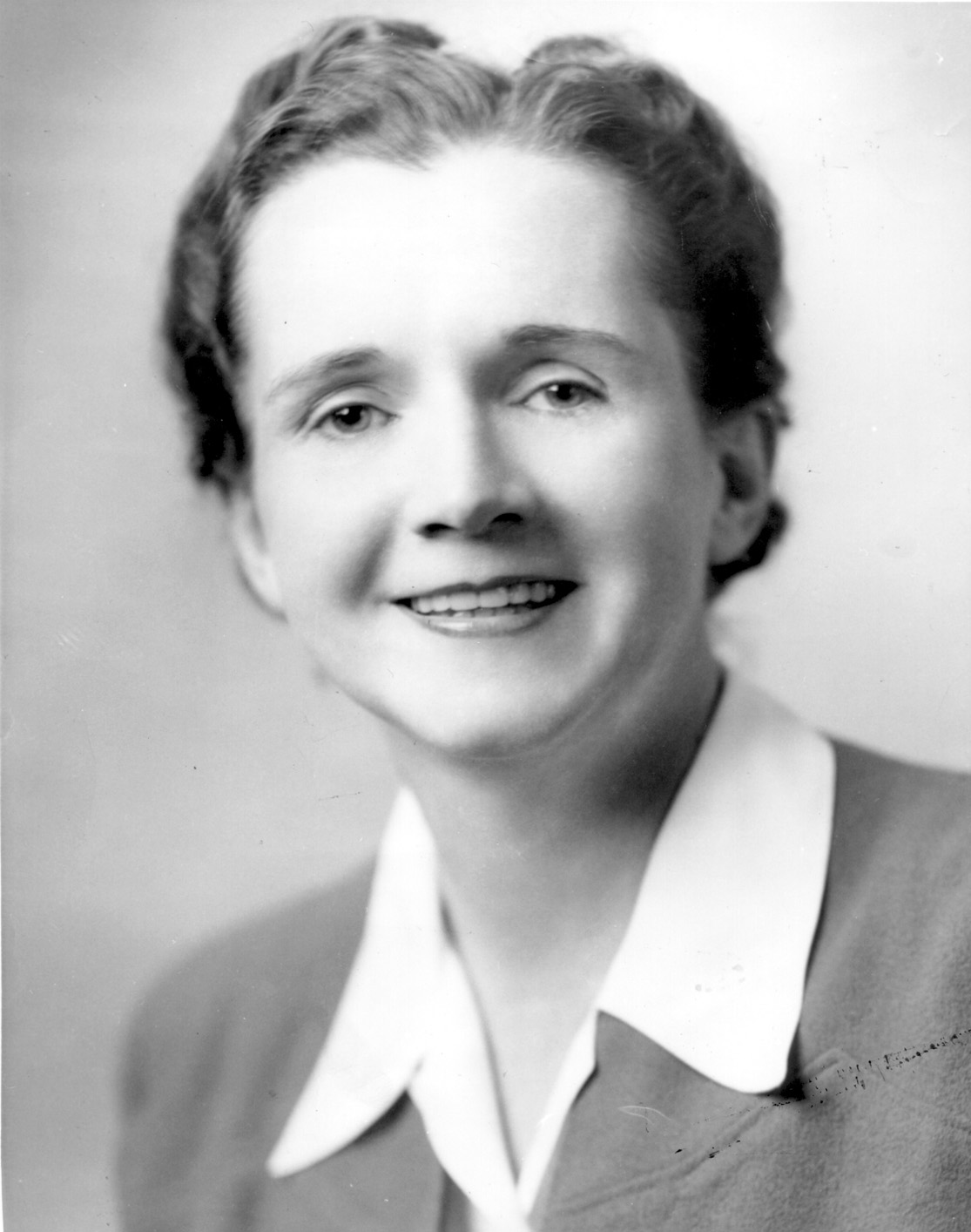 Rachel Carson is an inspiration. She taught us that our health depends on the quality of our environment. Her extraordinary responsibility and courage wakes up the voice in me that calls for action with a sense of political urgency as pollution and illness threaten the people and places I love.
We know that, in spite of the truth of her science, Rachel faced a deliberate campaign to discredit her. Today we must be equally resolute in confronting the ongoing attempts to bamboozle us with slick ads for natural gas, pink ribbons on carcinogenic products, or meaningless labels with false claims of safe and natural.
We can not afford to be indifferent or passive. Rachel’s example calls us all to stand up, sign up, speak up, and team up to conserve our natural resources and to work for clean energy, clean water, clean air and safe food.
We don’t have to think of ourselves as whistle blowers or canaries in the mine, but as guardians, steadfast sentries, the defenders of our community. We can imagine ourselves to be sentinel lions, the universal symbol of protection at the entrances of cities, libraries, schools, bridges...guarding the treasures of community.
Join voices with Green Decade and other advocates such as Clean Water Action, the Conservation Law Foundation, Food and Water Watch, Toxics Action Center, Mass Breast Cancer Coalition, the Union of Concerned Scientists and 350.org.
Tell your friends and tell our policy makers that we want divestment from fossil fuels and investment in safe renewable energy. We want a meaningful carbon tax. We want to affirm that human beings, not corporations, are persons entitled to constitutional rights.
We want to preserve the effectiveness of antibiotics, to stop the cruelty of factory farming, to stop fracking, to stop Tar Sands, to eliminate plastic bags, plastic bottles and Styrofoam, and to plug the gas pipeline leaks in our streets. Let’s claim our right to be safe from products and packaging with hormone disrupting plasticizers, useless but carcinogenic flame retardants, herbicides (especially RoundUP), microbeads, and genetically engineered organisms.
May 27 is Rachel Carson’s birthday. On that day, take a moment to remember Rachel, especially her book Silent Spring and its message, “prevention is the imperative.” Rachel was right. Now the future is up to us.
-- Ellie Goldberg, www.healthy-kids.info
We tolerate cancer-causing agents in our environment at our peril…For those in whom cancer is already a hidden or a visible presence, efforts to find cures must of course continue. But for those not yet touched by the disease and certainly for the generation as yet unborn, prevention is the imperative need.” — Rachel Carson, Silent Spring
1/16/15
The Power of One Voice

A 50-Year Perspective on the Life of Rachel Carson is a groundbreaking documentary examining the life of Rachel Carson and the profound implications of her environmental work. Perfect for classrooms and community events, this 51-minute film features interviews with Rachel Carson’s adopted son, Roger Christie, her biographer, Linda Lear, and other notable writers, scientists and advocates. By highlighting the power of Carson’s voice, we hope to inspire others to add their voices to this essential conversation. ~Mark Dixon (Director/Producer) and Patricia DeMarco (Executive Producer)
http://powerofonevoicefilm.com/
Premiere in #Pittsburgh! January 29, 2015, at 7:00 P.M. at the National Aviary!
Remarks by Ellie Goldberg, May 2007: The Legacy of Rachel Carson (May 27, 1907 – April 14, 1964) VIDEO (2:50 min)
4/2/14
Remembering Rachel Carson who died fifty years ago, April 14, 1964. In her book Silent Spring (1962) she wrote, "It would be unrealistic to
suppose that all chemical carcinogens can or will be eliminated from
the modern world. But a very large
proportion are by no means necessities of life. By their elimination the
total load of carcinogens would be enormously lightened, and the threat
that one in every four will develop cancer would at least be greatly
mitigated. The most determined effort should be made to eliminate those
carcinogens that now contaminate our food, our water supplies, and our
atmosphere, because these provide the most dangerous type of contact --
minute exposures, repeated over and over throughout the years.
... For those in whom cancer is already a hidden or a visible presence, efforts to find cures must of course continue. But for those not yet touched by the disease and certainly for the generations as yet unborn, prevention is the imperative need. (Silent Spring, Chapter 14, One in Four)

... For those in whom cancer is already a hidden or a visible presence, efforts to find cures must of course continue. But for those not yet touched by the disease and certainly for the generations as yet unborn, prevention is the imperative need. (Silent Spring, Chapter 14, One in Four)
www.rachelcarson.org
 Life of Rachel Carson, founder of contemporary environmental movement, author of
Silent Spring, advocate of nature and environmental ethics, against the
misuse of chemical pesticides,breast cancer survivor and best selling
nature writer, marine biologist and literary celebrity.
Life of Rachel Carson, founder of contemporary environmental movement, author of
Silent Spring, advocate of nature and environmental ethics, against the
misuse of chemical pesticides,breast cancer survivor and best selling
nature writer, marine biologist and literary celebrity.
2/18/13
Science
journalists, be more like Rachel Carson: Work for government, then be advocates Science Codex, February 17, 2013
It has been more than 50 years since
Rachel Carson published her groundbreaking book "Silent Spring".
Derided by scientists at the time, she is now regarded as a hero by environmental
progressives and a villain by many others, but Carson certainly changed how the
public views environmentalism.
One area of Carson's career that is
often overlooked is her time as a government employee. This is where she got
her true start in journalism and it is the area G. Pascal Zachary, professor of
practice with the Consortium for Science, Policy and Outcomes at Arizona State
University, will be discussing at the 2013 American Association for the
Advancement of Science (AAAS) annual meeting in Boston. Zachary is part of the
panel, A 50 Year Legacy: Why does Rachel Carson Matter?
Zachary, who co-organized the panel
along with ASU professor Jane Maienschein, gave his talk, "Back to the
Future: The Rachel Carson 'Model' as a Response to the Crisis in Science
Journalism," today (Feb. 17).
"At a time when popular writers
wanted to write about serious subjects and devote themselves to learning, there
was little support for them commercially," Zachary said on Carson and her
early career. "I'm intrigued about how her career suggests a way forward
for government to support serious writing and journalism about science and the
environment."
Carson served as an information officer
with the U.S. Bureau of Fisheries and the Fish and Wildlife Service for nearly
two decades before becoming an independent writer. During that time, she
reported on news and findings from the agency.
Zachary believes Carson's experience
and work in this field is what shaped her later writings. Additionally, he saw
her early government work as an opportunity. With publications such as the New
York Times recently disposing of their environmental desk, Zachary thinks the
format of having government employees writing about science could be the way of
the future.
"I'm trying to see Rachel Carson
in both a historical sense and prefiguring and anticipating a movement that
will reform or revolutionize science journalism today," Zachary said.
"When I talk about her as a model
for the crisis in science journalism, what I mean is currently there is less
and less quality science journalism," he added. "As a community, we
have to figure out how to draw the line and get a minimal amount of quality
science journalism."
12/21/12
The Fracking of Rachel Carson
Silent Spring in an Age of Environmental Crisis
Wednesday, March 6, 2013 · 4 PM - 5 PM
Korenman Lecture, Humanities Forum, Social Sciences Forum
A cancer survivor, Dr. Sandra Steingraber has written extensively on the intersection of the environment and public health. She will discuss what we have learned, and failed to learn, in the 50 years since Rachel Carson’s publication of Silent Spring, and will examine the threat to public health that fracking poses.
Sandra Steingraber’s highly acclaimed book, Living Downstream: An Ecologist’s Personal Investigation of Cancer and the Environment presents cancer as a human rights issue. Originally published in 1997, it was the first to bring together data on toxic releases with data from U.S. cancer registries and won praise from international media including The Washington Post, Publishers Weekly, The Lancet, and The London Times.
Sponsored
by the Department of Gender and Women Studies with support from the
Department of American Studies, the College of Arts, Humanities and
Social Sciences, the Dresher Center for the Humanities, Geography and
Environmental Systems, Office of the Provost, Social Sciences Forum, and
Women in Science and Engineering
12/9/12
How did 'Silent Spring' shape America? | Minnesota Public Radio ... December 10, 2012

Historians have said that the
beginning of the American environmental movement can be traced back to
the date, 50 years ago, when Rachel Carson's "Silent Spring" was
published. The work shocked the public, led to the passage of the Clean
Water Act and the founding of the Environmental Protection Agency.
William Souder, author of "On a Farther Shore: The Life and Legacy of Rachel Carson," will join The Daily Circuit Monday, Dec. 10 to talk about Carson's landmark book.
"I think the message of 'Silent Spring' does still resonate," he said on The Diane Rehm Show earlier this year. "I think people are more sensitive now to the idea that we can contaminate the environment with chemicals. When Carson wrote 'Silent Spring' this was really not an idea that had occurred to people before. And that was one of the reasons that she drew such an explicit link between chemical contamination and the contamination that was then happening from nuclear testing around the world."
Linda Lear, author of "Rachel Carson: Witness for Nature," will also join the discussion.
This is the fourth and final look at one of the 88 titles on the Library of Congress' list of books that shaped America. We picked "Silent Spring" after listener requests.
READ MORE ABOUT "SILENT SPRING:"
How 'Silent Spring' ignited the environmental movement (New York Times)
Rachel Carson's lessons, 50 years after "Silent Spring" (New York Times)
Video: The legacy of "Silent Spring" (CBS News)
minnesota.publicradio.org/.../
(Courtesy Library of Congress)
William Souder, author of "On a Farther Shore: The Life and Legacy of Rachel Carson," will join The Daily Circuit Monday, Dec. 10 to talk about Carson's landmark book.
"I think the message of 'Silent Spring' does still resonate," he said on The Diane Rehm Show earlier this year. "I think people are more sensitive now to the idea that we can contaminate the environment with chemicals. When Carson wrote 'Silent Spring' this was really not an idea that had occurred to people before. And that was one of the reasons that she drew such an explicit link between chemical contamination and the contamination that was then happening from nuclear testing around the world."
Linda Lear, author of "Rachel Carson: Witness for Nature," will also join the discussion.
This is the fourth and final look at one of the 88 titles on the Library of Congress' list of books that shaped America. We picked "Silent Spring" after listener requests.
READ MORE ABOUT "SILENT SPRING:"
How 'Silent Spring' ignited the environmental movement (New York Times)
Rachel Carson's lessons, 50 years after "Silent Spring" (New York Times)
Video: The legacy of "Silent Spring" (CBS News)
minnesota.publicradio.org/.../
12/7/12
OMG I HEART Rachel Carson: Social Media and Environmental Info
Air date: Week of 12/08/2012
What would Rachel Carson tweet? Take shelter from Saturday's rain at the
Rachel Carson Homestead in Springdale. The Allegheny Front's Jennifer
Szweda Jordan is leading a salon-style discussion on social media and
the environmental hero to celebrate the 50th anniversary of Silent
Spring. The Homestead will be open from noon to 5. Salon conversations
begin at 3. Event is free. Contact jennifer@alleghenyfront.org for more
information.
On http://alleghenyfront.org/index.html
Air date: Week of 12/08/2012
 |
On http://alleghenyfront.org/index.html

12/4/12
Seacoast towns paying tribute to Rachel Carson
Area groups taking year-long look at legacy of 'Silent Spring'

YORK, Maine — A consortium of York and regional
environmental groups have banded together to offer a yearlong look at
the legacy of scientist and environmental activist Rachel Carson, on the
50th anniversary of her book "Silent Spring."
This
Thursday evening, a live video conference will be offered at the York
Public Library of a panel discussion being held at the Portland Public
Library. Scientists and researchers from throughout the state will
explore the impacts and implications of "Silent Spring."
Published
in 1962, "Silent Spring" documented the detrimental effects of
pesticides on the environment, particularly birds. It has long been
credited with launching the modern environmental movement.
Carson
lived in Maine during part of her life, and the Rachel Carson National
Wildlife Refuge was established in 1966 along the coast between Kittery
and Cape Elizabeth.
The recent local focus on
Carson began with York Reads, a York group headed by York Public Library
Director Robert Waldman, which picks a book each year for the community
to read.
Waldman said when they were
discussing what book to chose for the 2012-13 year, which begins in the
fall, someone mentioned "Silent Spring."
"I
said it seems to me if we're going to do that, we have to get the
community involved," said Waldman. "Each person got in touch with
someone else and before you knew it, we had quite a significant group."
The
group now includes the Center for Wildlife, Cornerstones for Science,
the Mount Agamenticus Conservation Program, the Rachel Carson National
Wildlife Refuge, RiverRun Bookstore, White Pines Program, York Adult
Education, York School Department, York Art Association, Greater York
Chamber of Commerce, York Energy Efficiency Committee, York Land Trust,
the York Rivers Association, and Gateway to Maine: Outside.
Read More: http://www.seacoastonline.com/articles/20121204-NEWS-212040379
Upcoming events
• Dec. 6: Video conference at York Public Library about "Silent Spring." 7-9 p.m., "Silent Spring: 50
Years Later." The panelists will discuss the legacy of the book from
scientific, historical and literary approaches. Included will be marine
biologists, scientists and oceanographers.
•
Dec. 11: Center for Wildlife: "Celebrating Rachel Carson: Exploring
unseen connections between wilflife and human health." 6-7:30 p.m.
• Jan 18: Film "Living Downstream," York Public Library
• Feb. 15: Film "The Story of Stuff," York Public Library
• March 8: Film "Mother, Caring for 7 Billion," York Public Library
12/2/12
Cats and Dogs, Sentinels in a Silent Spring | Poisoned Pets.
www.poisonedpets.com/cats-and-
www.poisonedpets.com/cats-and-

This year marks the 50 year anniversary for Rachel Carson’s book Silent Spring.
The eponymous book that warned of the dangers of pesticides, a book
many say prompted the environmental movement, led to the banning of the
pesticide DDT a decade later.
What many people don’t realise is that today, 50 years after Silent Spring
was published, we are exposed to more toxic chemicals than ever before,
an estimated 8,000-12,000 chemicals continue to be introduced annually,
with no requirement that human toxicity or exposure data be provided
before the chemical is used.
“Like the constant dripping of water
that in turn wears away the hardest stone,” she wrote in her 1962 book,
“this birth-to-death contact with dangerous chemicals may in the end
prove disastrous.”
Read article: http://www.poisonedpets.com/cats-and-dogs-sentinels-in-the-silent-spring/
Read article: http://www.poisonedpets.com/cats-and-dogs-sentinels-in-the-silent-spring/
10/11/12
After 50 Years Silent Spring is More Relevant than Ever
Carl Zichella’s Blog
Posted October 11, 2012 in Curbing Pollution, Health and the Environment, Living Sustainably, Solving Global Warming, The Media and the EnvironmenThe human race is challenged more than ever before to demonstrate our mastery, not over nature but of ourselves. -- Rachel Carson (1907-1964)
Last month marked the 50th anniversary of the publication of Silent Spring by Rachel Carson, one of the most influential books of the 20th century and one of the most passionate pleas for the conservation of nature and restraint in tampering with the processes that govern life ever written. As a recent New York Times magazine piece illustrated, Carson’s reward was a leading place in the pantheon of environmental leaders and the undying and hysterical hatred of the chemical industry’s mouthpieces and apologists.
Read more: http://switchboard.nrdc.org/blogs/czichella/after_50_years_silent_spring_i.html
10/9/12
 Please
join us on October 18, 2012 for a series of events commemorating the
fiftieth anniversary of the publication of Rachel Carson's landmark
work, Silent Spring and a half century of environmental
awareness. All events will take place on the campus of Connectictut
College and will be free and open to the public. Events will include a
panel discussion reflecting on Rachel Carson and her legacy, held in
Ernst Common Room of Blaustein Hall from 3:30 to 5:00 PM. The panel will
be chaired by Linda Lear, author of the award-winning biography Rachel Carson: Witness for Nature and will include:
Naomi Oreskes, Professor of History and Social Science at the University of California, San Diego and author of Merchants of Doubt: How a Handful of Scientists Obscured the Truth on Issues from Tobacco to Global Warming
Peter Siver, Professor of Botany and Director of the Environmental Studies Program at Connecticut College
Helen Rozwadowski, Associate Professor of History, University of Connecticut
Wendy Blake-Coleman, Office of Environmental Information, Environmental Protection Agency
Following the panel until 6:00 PM, there
will be a reception in the Charles E. Shain Library and viewing of the
exhibit Rachel Carson's Silent Spring: Rumblings of an Avalanche. The
exhibit draws on material from the Rachel Carson Collection in the Lear
Center for Special Collections & Archives illustrating the growing
concern around DDT in the 1950s, Carson's plans for a book on the
overuse of pesticides, the publication of Silent Spring, and the
response to the book by the federal government, the pesticide industry,
and the general public.
The day's events will conclude with a
lecture at 7:30 PM in the Ernst Common Room, by ecologist, author, and
environmental advocate Sandra Steingraber. A cancer survivor, Dr.
Steingraber has written extensively on the intersection of the
environment and public health first in 1997 with Living Downstream: An Ecologist's Personal Investigation of Cancer and the Environment and later with Having Faith: An Ecologist's Journey to Motherhood. Steingraber's most recent book, Raising Elijah
is a call to action for what she calls the greatest moral crisis of our
time: the environmental crisis.
Sandra Steingraber has been heralded as
"the new Rachel Carson" for her ability to translate current scientific
research for the general public. She has participated in briefings of
the United States Congress, the United Nations, and the President's
Cancer Panel and has been a guest on The Today Show and Good Morning
America.
Five Decades after Silent Spring is being
made possible by the Sound Lab Foundation, the Friends of the
Connecticut College Library, Connecticut College Information Services,
the Lear Center for Special Collections & Archives, the
Goodwin-Niering Center for the Environment, and Dr. Linda Lear.
For more information about the day's events
or the Rachel Carson Collection at Connecticut College, please contact
Benjamin Panciera at benjamin.panciera@conncoll.edu or by telephone at 860-439-2654.
9/23/12
 Living on Earth:
Silent Spring Turns 50
Rachel Carson's legacy includes the ban on pesticides like DDT in the United States but a cocktail of other dangerous chemicals is still in use. Frank Graham is an editor with the Audubon Society and author of a follow up to Carson’s work“Since Silent Spring”. Graham talks to host Steve Curwood about the use of pesticides in the US then and now.
www.loe.org/shows/segments.
9/21/12
The 50th Anniversary Of ‘Silent Spring’ Reminds Us Of The Importance Of Environmental Regulations by Arpita Bhattacharyya
This year marks the 50th Anniversary of the release of Rachel Carson’s Silent Spring, a book often credited with launching the modern environmental movement. As we celebrate recent vital regulations, from new fuel economy standards to carbon pollution standard, it’s important to look back on how one book moved the American public to realize the importance of environmental protection and called the government to action.Read more: http://thinkprogress.org/climate/2012/09/21/888111/the-50th-anniversary-of-silent-spring-reminds-us-of-the-importance-of-environmental-regulations/
9/14/12
Silent Spring and Sustainability Brownbaggers
Tri States Public Radio
 Rich
Egger's guests on Emphasis for September 14 are Amy Mossman and Timothy
Collins of Western Illinois University. They talk about the fall lineup
for the Sustainability Brownbaggers series.
The brownbaggers are billed as “Conversations for the Natural and Social Sciences, Art and Humanities, and Business.”
Mossman and Collins will present the first program, which will focus on “Silent Spring.” This fall marks the 50th anniversary of the publication of Rachel Carson's book.
“It probably resonates with me most strongly because I feel that she really is advocating for an empowerment of the public. One of the things that she does in her book is take scientific information that was known and make it available to the public,” Mossman said of Carson and “Silent Spring.”
Mossman said Carson also presented issues of scientific uncertainty -- she helped the public understand there is still a great deal that is unknown.
Collins said he first read the book when he was a high school sophomore. He recently re-read it as he prepared for the brownbaggers series.
“What I like about it is her courage. It took a lot of stuff to stand up and write a book that was highly critical of the major chemical industry, the major agricultural industry, and those relationships,” Collins said.
Brownbaggers will be held on Tuesdays, 12:30 pm - 1:30 pm, Malpass Library West, 4th Floor, Western Illinois University.
The schedule:
September 18 -- 50th Anniversary of Rachel Carson's “Silent Spring”
September 25 -- Green Chemistry: Retooling of Chemistry and Making it More Sustainable
October 2 -- Sustainability on the Upper Mississippi River
October 9 -- Green Politics
October 16 -- An Overview of Sustainability in the Fashion Industry: Sustainable Technologies
October 23 -- The Aftermath of Hurricane Katrina
October 30 -- 150th Anniversary of the Land Grant System
November 13 -- Earth Cafe
9/4/12
The Life and Legacy of Rachel Carson
Events and Conferences from Around the World
If you would like to include a conference or an event, please email michael.friscia@yale.edu with conference information and materials.Linda Lear's Appearances - Rachel Carson Series

Location:
Montreal, CA. Magill University. Sept.19-21
Raleigh, NC. NC State. Sept. 27-29
Five Decades After Silent Spring . A Symposium at Connecticut College, New London. CT. Oct 17-19
Five Decades After Silent Spring
A Symposium at Connecticut College, New London. CT. Oct 17-19Visit Website

Sandra Steingraber, featured speaker
Featuring a panel of environmental activists and scholars including Dr. Naomi Orestes, author of Merchants of Doubt.(italics) and visiting scholar Coner Jameson author of Silent Spring Revisited.
Our Planet and Our Health- The Impact of Silent Spring after Fifty Years
Download PDF Date: October 26, 2012 from 1:00 pm to 5:00 pmLocation: Chatham University Eddy Theater
Visit Website
Rachel Carson’s book Silent Spring, published 50 years ago in 1962, brought global attention to the consequences of unrestrained use of toxic pesticides such as DDT. Among the actions taken in response to her work was a ban on DDT by the newly formed Environmental Protection Agency in 1976, over a decade after Rachel Carson’s death. The success of Silent Spring and its rapid popularity was based on Rachel Carson’s reputation and credibility as a writer and scientist on the subject of the oceans. Her books The Sea Around Us, The Edge of the Sea and Under the Sea Wind established her in the public eye as a significant scholar and writer. Thus, in celebrating the fiftieth anniversary of publication of Silent Spring, it is appropriate to turn to the oceans as a touchstone for evaluating the impact of her work.
9/3/12
Rachel Carson's Prescience Chronicle of Higher Education
Fifty years ago, on September 27, 1962, Houghton Mifflin published Rachel Carson's Silent Spring, among the 20th century's most influential books. To honor the anniversary, the University of Cape Town invited me to lead an interdisciplinary forum this ...
Fifty years ago, on September 27, 1962, Houghton Mifflin published Rachel Carson's Silent Spring, among the 20th century's most influential books. To honor the anniversary, the University of Cape Town invited me to lead an interdisciplinary forum this ...
Subscribe to:
Posts (Atom)
