2/8/16


Buyer Beware Of 3-D Printer Emissions
Source: Chemical & Engineering News, January 25, 2016
Author: Jyllian Kemsley 

As costs of three-dimensional printers drop and the devices increasingly make their way into offices, schools, and homes, users should consider how to limit exposure to emissions of particles and gases in the space where the printer is located. This caution stems from research by a team led by Brent Stephens of Illinois Institute of Technology and Neil E. Crain of the University of Texas, Austin ... . The researchers tested the emissions of five commercially available desktop 3-D polymer-extrusion printers for ultrafine particles, which have a diameter less than 100 nm, and volatile organic compounds, including caprolactam and styrene. They used the printers to make a standard part from nine different polymer filament starting materials. The emissions varied more by the type of material than they did by the type of printer. Modeling the emissions in a 45 m3 air-conditioned office, the team predicts that caprolactam and styrene would reach concentrations that could be harmful to health.
Read more...

See original article in Environmental Science & Technology, "Emissions of Ultrafine Particles and Volatile Organic Compounds from Commercially Available Desktop Three-Dimensional Printers with Multiple Filaments".
BPS, like BPA, disrupts estrogen and thyroid hormones.

BPA-free plastic alternatives may not be safe as you think   by Sandee LaMotte February 1, 2016, CNN http://www.cnn.com/2016/02/01/health/bpa-free-alternatives-may-not-be-safe/index.html

BPA-free alternatives may be no safer than BPA, say researchers.   Most common alternative, BPS, linked in study to disruptions of estrogen and thyroid hormones

(CNN)Your "BPA-free" plastic product may be no safer than the product it replaced, says a new UCLA study that analyzed the impact of a common BPA alternative on zebra fish embryos. The study joins a small but growing group of similar research sounding the alarm about so called "BPA-free" alternatives.

"Our findings are frightening and important," said senior author and reproductive endocrinologist Nancy Wayne. "Consider it the aquatic version of the canary in the coal mine."

After decades of animal research linked BPA (Bisphenol A), a known endocrine disruptor, to problems with brain and reproductive development, early puberty and a rise in breast and prostate cancer, many manufacturers stopped using the chemical to harden plastics, replacing it with "BPA-free" alternatives. The most common replacement is BPS (Bisphenol S), said Wayne....
...The Breast Cancer Fund recommends that consumers wishing to limit exposure to possible toxins in BPA, BPS and other alternatives use glass, stainless steel and food safe ceramic containers for food and water storage. They stress that it's not safe to microwave in plastic. Other suggestions include using gloves to handle thermal paper receipts, and researching canned goods to find those that no longer use plastic liners.

12/17/15

FOR IMMEDIATE RELEASE

Massachusetts Legislators submit letter to United States Consumer Product Safety Commission

Tire crumb rubber and rubber mulch request for regulation and analysis submitted
 
December 16, 2015 -  Massachusetts delegates including Senator Karen Spilka, State Representatives Jeff Roy and John Fernandes have requested the Consumer Product Safety Commission (CPSC) regulate interior and exterior use of crumb rubber as a children's product due to exposure on playground and artificial turf fields.

Tire crumb rubber and rubber mulch is used in playgrounds and turf fields across the U.S. The usage began in the 90s as a way to dispose of used tires. Typically, the fields and playgrounds are sold to a city or state with promise of less maintenance and increased playtime,  yet the tire derived materials have never been evaluated by the CPSC for exposure risk to users.

The delegate's letter to the CPSC requests analysis to offer concrete conclusions and recommendations to ensure the safety of children and adults who use crumb rubber and turf fields. Specifically, the delegates requested the CPSC investigate:
  • Identifying potential hazards resulting from ingestion and inhalation of toxins released from crumb rubber during heat spikes and outgassing;
  • Detecting the existence of known human carcinogens;
  • Locating the presence of lead and other toxins;
  • Examining any danger presented by the natural aging and decomposition; and
  • investigating any potential risks to child or adult users.
---------------
 
Thanks to Nancy Alderman for forwarding this announcement.
 
Nancy Alderman, President
Environment and Human Health, Inc.
1191 Ridge Road
North Haven, CT   06473
(phone) 203-248-6582
(Fax)     203-288-7571

8/27/15

Community Air Monitoring Training: Videos Now Available 

July 9, 2015, EPA’s Community Air Monitoring Training was held at the Agency’s Research Triangle Park campus (RTP). The purpose of the training workshop was to share tools used to conduct citizen science projects involving Next Generation Air Monitoring (NGAM) technology and to educate interested groups and individuals on best practices for successful air monitoring projects.

The videos from the morning presentations are now available on the Community Air Monitoring Training, and are part of the Air Sensor Toolbox for Citizen Scientists and intended to serve as resources for anyone interested in learning more about monitoring air quality. Please feel free to share the link with others: www2.epa.gov/air-research/community-air-monitoring-training. Also, check out the blog announcing the video release.

Direct links to the videos are available here: Air Quality Monitoring and Sensor Technologies by Ron Williams, project Lead for EPA’s Office of Research and Development emerging technology research area. How to Start a Citizen Science Program by Liz Barry, Co-founder and Director of Community Development at the Public Laboratory for Open Technology and Science. Citizen Science Study Design by Rachelle Duvall, Research Physical Scientist in EPA’s Office of Research and Development. Data Measurement, Management, Quality, Uncertainty by Bob Judge, Air Monitoring Team Leader in EPA’s Region 1 Office in Boston. Quality Assuranceby Ron Williams, Project Lead for EPA’s Office of Research and Development emerging technology research area. Short Term Measurements and Air Quality Messaging/ Regulatory Requirements for Data by Kristen Benedict, Atmospheric Scientist in EPA’s Office of Air Quality Planning and Standards.

00701

If you are not already a member, the Office of Environmental Justice would like to invite you to join the EJ ListServ. The purpose of this information tool is to notify individuals about activities at EPA in the field of environmental justice. By subscribing to this list you will receive information on EPA's activities, programs, projects grants and about environmental justice activities at other agencies. Noteworthy news items, National meeting announcements, meeting summaries of NEJAC meetings, and new publication notices will also be distributed. Postings can only be made by the Office of Environmental Justice. To request an item to be posted, send your information to environmental-justice@epa.gov and indicate in the subject “Post to EPA-EJ ListServ”

To join the listserv go to: https://lists.epa.gov/read/all_forums/subscribe?name=epa-ej

6/16/15

Our Health Comes First. Ban Leaf Blowers
Good Health Is Good Business  
From Ellie Goldberg, Newton, MA 02459 6/5/15
TO: kdean@newtonma.gov, Program and Services Committee, Newton Aldermen
RE:  Proposed Ordinance #31-15 (LEAF BLOWERS)
~~~~~~
We share the air. Let's take BETTER ACTION NOW (BAN).

We need a public health policy based on an ethic of community that sets a high standard for health protection and pollution prevention.

I hope you agree that it is unacceptable that in a short fifteen-minute early morning walk to the Newton Center T station from my home you would walk through the gritty fog created by from five to ten crews each using multiple leaf blowers.    

We need to stop the use of leaf blowers to protect us all from the deafening barrage of noise and noxious clouds of fumes, particulates, pesticides, feces, mold and pollen that assault us not only when we are outside but that come through our windows into our homes.  

Please do not be confused by business owners who defend leaf blowers as a wonderful innovation and claim that it is more efficient to use leaf blowers or that they would need to charge higher fees.

That claim reminds me of a phone call I got when I started working to try to stop Newton's use of pesticides on the school playing fields and parks. The angry caller told me that her family depended on her husband's job as a pesticide applicator. I told her that I support pest control professionals who are knowledgeable about preventative and corrective measures, but that I do not accept that a business has a license to poison my children or her children.

In fact, the use of leaf blowers indicates an ignorance of or indifference to good horticultural principles and safe practice. For example, the landscape crew that works across the street from me often has three or more leaf blowers going at the same time, often chasing just a few leaves off a driveway. Then they stroll up the street to another client, leaf blowers going, spewing street debris, mold spores, weed seeds, and fungal diseases on gardens and lawns far and wide.

A full ban would protect even those neighbors who ignore the damage and distress they cause themselves and others.  And it would protect the workers who are the most exposed to the air pollution and noise. Most often they work with no personal protection equipment. We know they will live with the lung damage and hearing loss for the rest of their lives.  

A full ban on leaf blowers would show that Newton values our health and supports those local professionals whom we can trust to safeguard our health and the health of our landscapes. 

Good health is good business.  I support a full ban on leaf blowers and urge you to take 
BETTER ACTION NOW.
 100_6035.JPG

6/11/15

The more they dig, the more they find: DDT cleanup continues for mid-Michigan town. http://www.environmentalhealthnews.org/ehs/news/2015/jun/michigan-superfund-ddt-epa-birds-health-pesticide
Federal, state officials are making progress cleaning up harmful chemicals in St. Louis, Michigan, but more work remains and there is still no health study.*
June 11, 2015 By Brian Bienkowski Environmental Health News

ST. LOUIS, Mich. — During recent summers birds were found littered around the town, poisoned with a long-banned pesticide.

This summer? The school athletic grounds, where kids practice football and softball, are being dug up after it was discovered they too are contaminated with DDT.

It is the latest chapter in a seemingly endless effort to rid this small, rural mid-Michigan town of toxic chemicals that have plagued it since the 1960s. And, despite wildlife deaths and some lawns contaminated to levels deemed harmful to humans, no one is conducting health testing on DDT exposure in the community.

Schoolyard contamination
St. Louis, an hour drive north of state capital Lansing, has long dealt with contamination left behind by the Velsicol Chemical Corp., formerly Michigan Chemical, which manufactured pesticides until 1963 and abandoned loads of DDT, which was banned 40 years ago.


The pesticide was made famous by Rachel Carson’s book Silent Spring, which exposed the hazards of DDT, especially for birds, in 1962. Populations of bald eagles and other birds crashed when DDT thinned their eggs, killing their embryos. Exposure also has been linked to multiple health problems in humans, especially developing babies.

*Read full article

4/29/15


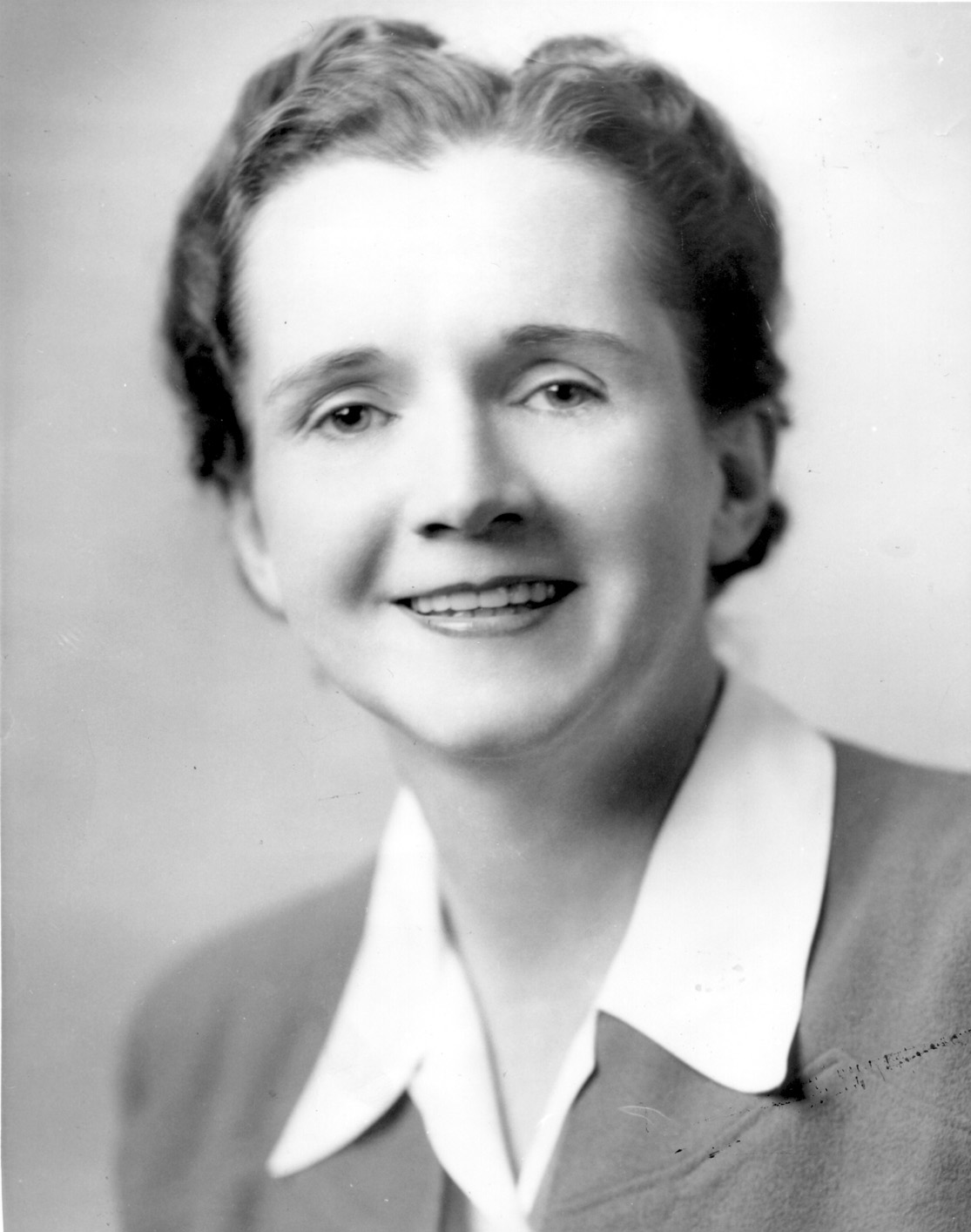
Rachel Carson fws pub domain.jpgRachel Carson is an inspiration. She taught us that our health depends on the quality of our environment. Her extraordinary responsibility and courage wakes up the voice in me that calls for action with a sense of political urgency as pollution and illness threaten the people and places I love. 

We know that, in spite of the truth of her science, Rachel faced a deliberate campaign to discredit her. Today we must be equally resolute in confronting the ongoing attempts to bamboozle us with slick ads for natural gas, pink ribbons on carcinogenic products, or meaningless labels with false claims of safe and natural. 

We can not afford to be indifferent or passive. Rachel’s example calls us all to stand up, sign up, speak up, and team up to conserve our natural resources and to work for clean energy, clean water, clean air and safe food.

We don’t have to think of ourselves as whistle blowers or canaries in the mine, but as guardians, steadfast sentries, the defenders of our community. We can imagine ourselves to be sentinel lions, the universal symbol of protection at the entrances of cities, libraries, schools, bridges...guarding the treasures of community.

Join voices with Green Decade and other advocates such as Clean Water Action, the Conservation Law Foundation, Food and Water Watch, Toxics Action Center, Mass Breast Cancer Coalition, the Union of Concerned Scientists and 350.org. 

Tell your friends and tell our policy makers that we want divestment from fossil fuels and investment in safe renewable energy. We want a meaningful carbon tax. We want to affirm that human beings, not corporations, are persons entitled to constitutional rights. 

We want to preserve the effectiveness of antibiotics, to stop the cruelty of factory farming, to stop fracking, to stop Tar Sands, to eliminate plastic bags, plastic bottles and Styrofoam, and to plug the gas pipeline leaks in our streets. Let’s claim our right to be safe from products and packaging with hormone disrupting plasticizers, useless but carcinogenic flame retardants, herbicides (especially RoundUP), microbeads, and genetically engineered organisms.

May 27 is Rachel Carson’s birthday. On that day, take a moment to remember Rachel, especially her book Silent Spring and its message, “prevention is the imperative.”  Rachel was right. Now the future is up to us​.​

-- Ellie Goldberg, www.healthy-kids.info

We tolerate cancer-causing agents in our environment at our peril…For those in whom cancer is already a hidden or a visible presence, efforts to find cures must of course continue.  But for those not yet touched by the disease and certainly for the generation as yet unborn, prevention is the imperative need.” — Rachel Carson, Silent Spring

3/31/15

Clip: The Bravery of Rachel Carson billmoyers.com

  "The most alarming of all man’s assaults upon the environment is the contamination of air, earth, rivers, and sea with dangerous and even lethal materials. This pollution is for the most part irrecoverable; the chain of evil it initiates not only in the world that must support life but in living tissues is for the most part irreversible. In this now universal contamination of the environment, chemicals are the sinister and little-recognized partners of radiation in changing the very nature of the world — the very nature of its life." -- From Rachel Carson's 1962 book Silent Spring


Biologist Rachel Carson didn't want to write the blockbuster Silent Spring but felt a responsibility to do so.  billmoyers.com