12/30/12

Rachel Carson Book Discussion Group 

January 20, 2 - 3:30 p.m.

2400 Valley Parkway, North Olmsted , OH. 44070 

12/23/12

Today’s Rachel Carson

Today’s Rachel Carson is a woman I know, admire and love, Dr. Beverly Paigen. I was reminded of how important Dr. Paigen is when asked to present her with an award from the Maine Environmental Health Strategies Center.

When I began to think about what I would say about Dr. Paigen I realized how groundbreaking her research was back in 1978 at Love Canal. How when she presented her theories and her research findings around the Love Canal chemicals and adverse health problems she was dismissed, ridiculed, and harassed by those who wanted to silence her, just like Rachel Carson.

Beverly demonstrated how the chemicals had likely moved out of the dumpsite the Love Canal and into the homes that surrounded the site. Again she was dismissed. Today, there is a name for this movement of chemicals called vapor intrusion and there is even an EPA approved technology to remove the chemicals from homes called vapor intrusion mitigation technologies.

...

Read the whole article: http://chej.org/2012/12/today%E2%80%99s-rachel-carson/

12/21/12

The Fracking of Rachel Carson

Silent Spring in an Age of Environmental Crisis

Wednesday, March 6, 2013 · 4 PM - 5 PM

Korenman Lecture, Humanities Forum, Social Sciences Forum

A cancer survivor, Dr. Sandra Steingraber has written extensively on the intersection of the environment and public health. She will discuss what we have learned, and failed to learn, in the 50 years since Rachel Carson’s publication of Silent Spring, and will examine the threat to public health that fracking poses.

Sandra Steingraber’s highly acclaimed book, Living Downstream: An Ecologist’s Personal Investigation of Cancer and the Environment presents cancer as a human rights issue. Originally published in 1997, it was the first to bring together data on toxic releases with data from U.S. cancer registries and won praise from international media including The Washington Post, Publishers Weekly, The Lancet, and The London Times.

Sponsored by the Department of Gender and Women Studies with support from the Department of American Studies, the College of Arts, Humanities and Social Sciences, the Dresher Center for the Humanities, Geography and Environmental Systems, Office of the Provost, Social Sciences Forum, and Women in Science and Engineering

12/17/12

Poisoned Dog Injures Veterinarians -  Pets are frequently exposed to toxic chemicals used for lawn care, bug sprays, flea and tick products, and rodenticides.
-- http://beyondpesticides.org/
Pest Prevention By Design Guidelines is a new free resource for designing buildings to be resistant to common pests, such as rats, mice, pigeons and cockroaches. San Francisco’s Integrated Pest Management Program initiated the project after initial pesticide use reductions achieved by the program began to level off.  Program participants suspected poor design was a key barrier to further reductions. 

The resource aims to compile the current body of knowledge about preventing pest problems through building design and construction.  Pest management professionals, architects, engineers, researchers, educators, green building experts, IPM consultants and public agency experts contributed. 

The final product is now posted at:
 
The project was funded by the US Centers for Disease Control, coordinated by the Center for Environmental Health was contracted to coordinate the project, and the guidelines were reviewed by the International Code Council and a national, cross-sector team of experts.

To join or leave this listserv, visit the School IPM WWW site at http://schoolipm.ifas.ufl.edu/ and follow the instructions under "School IPM Listserv."

Webinar - Hurricane Sandy: Protecting Workers and Volunteers from Mold

Jack Caravanos, DrPH, CIH, Professor at the City University of New York (CUNY) School of Public Health at Hunter College presented information on how to effectively protect yourself when working in a moldy environment. The webinar was held on December 11, 2012 from 10:00 – 11:00 a.m. EST. For more information, please contact Mitchel Rosen at mrosen@umdnj.edu. This program is sponsored by the Office of Public Health Practice at the UMDNJ-School of Public Health.

12/13/12


PEACE IN NATURE: Aylee Tudek, 16, Shares Her Sense of Wonder, 12/10/12

“If I had influence with the good fairy who is supposed to preside over the christening of all children I should ask that her gift to each child in the world be a sense of wonder so indestructible that it would last throughout life, as an unfailing antidote against the boredom and disenchantments of later years, the sterile preoccupation with things artificial, the alienation from the sources of our strength.”
― Rachel Carson, ‘The Sense of Wonder’


The sun was surely burning my back; at least it felt like it. I had on my new bikini top with a halter-top over it. Yesterday had been the hottest day yet this year. The grass was finally a healthy green and the dandelions were blooming. The land had come alive with insects swarming over the grass in a cacophony of inaudible background noise. Fairy-pink apple blossoms filtered down through the branches and slanted into the grass, scenting the air. The heavy humidity amplified the scent of rotting fruit issuing from the chicken coop behind me. The smell coming in pungent waves broken up by the recurring sweet odor of the apple blossoms.
Everything was such a bright shade in the sun. Being used to the gray monotony of school and the inside of cars caused nature to appear unnatural. It was a horrifying realization.
I looked more intently at my surroundings. In front of me were the beehives, two of them, a creamy yellow color. Bees spilled out of the open slat in the front, crawling over each other in a gentle frenzy. They whizzed past my head like little torpedoes, missing me each time. The ones coming back from the fields were laden with pollen, appearing to have yellow saddlebags on their back legs.

Read the complete essay at LINK

Aylee Tudek is a 16-year old student at Mt. Abraham Union High School in Bristol, VT. She writes: “Inspired by ‘Last Child in the Woods’ and participating in a composition writing class, I wrote this piece depicting watching the bee hives on my farm." She was "moved to share it with those who may not yet have had the chance to find peace in nature.” 
12/9/12

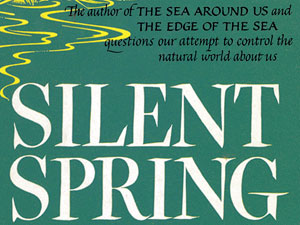
How did 'Silent Spring' shape America? | Minnesota Public Radio ... December 10, 2012

Historians have said that the beginning of the American environmental movement can be traced back to the date, 50 years ago, when Rachel Carson's "Silent Spring" was published. The work shocked the public, led to the passage of the Clean Water Act and the founding of the Environmental Protection Agency. 

William Souder, author of "On a Farther Shore: The Life and Legacy of Rachel Carson," will join The Daily Circuit Monday, Dec. 10 to talk about Carson's landmark book. 

"I think the message of 'Silent Spring' does still resonate," he said on The Diane Rehm Show earlier this year. "I think people are more sensitive now to the idea that we can contaminate the environment with chemicals. When Carson wrote 'Silent Spring' this was really not an idea that had occurred to people before. And that was one of the reasons that she drew such an explicit link between chemical contamination and the contamination that was then happening from nuclear testing around the world." 

Linda Lear, author of "Rachel Carson: Witness for Nature," will also join the discussion. 

This is the fourth and final look at one of the 88 titles on the Library of Congress' list of books that shaped America. We picked "Silent Spring" after listener requests. 

READ MORE ABOUT "SILENT SPRING:"
How 'Silent Spring' ignited the environmental movement (New York Times)
Rachel Carson's lessons, 50 years after "Silent Spring" (New York Times)
Video: The legacy of "Silent Spring" (CBS News)

minnesota.publicradio.org/.../daily-circuit-rachel-carson-silent-...